Hot Flashes and Night Sweats: A Midlife Rehydration Plan
A practical morning-and-evening routine to replace fluids lost to vasomotor symptoms, without overcorrecting in either direction.
If you are waking at four with the sheets damp and the air thick, you are not imagining how much fluid the night took out of you. Vasomotor symptoms — the medical name for hot flashes and night sweats — are one of the more demanding parts of the perimenopause transition, and while the body recovers from each one quickly, the cumulative effect on hydration is real. Replacing what you have lost, in the right way and at the right time, is one of the small things that makes the next day easier.
This piece is general guidance for women in the menopause transition. If your night sweats are sudden, severe, or accompanied by other symptoms, that belongs in a conversation with your own clinician — not least because there are a number of treatable medical reasons besides perimenopause that cause heavy night sweating.
What’s happening on a sweating night
A hot flash begins with a small misfire in the body’s thermostat. Falling and fluctuating estrogen disrupts the hypothalamus’s narrow comfort zone, and the body briefly behaves as if you are overheating when you are not. Blood vessels in the skin dilate, the heart rate climbs slightly, the chest and face flush, and sweat glands open. The sweat is the cooling response — and it works. Within a minute or two the body sheds heat, the flush passes, and the temperature returns to baseline.
That two- or three-minute event is harmless on its own. The challenge is that the sweat is real fluid, and when it happens five or eight times across a night, the totals add up. A long night of moderate sweats can easily move half a litre of water through the skin, sometimes more. Most women will not feel acutely dehydrated in the morning — but they will often feel headachy, slightly dizzy on standing, or duller than the previous day’s sleep would explain. Quietly, hydration is doing some of the work of that morning fog.
What night sweat fluid actually contains
Sweat is mostly water, with sodium and chloride as the main electrolytes and a smaller amount of potassium. The exact composition varies between people and across the menstrual cycle when one is still cycling, but the rough rule holds: a heavy sweating night moves more salt than most people imagine.
This matters because chasing fluid alone — drinking large quantities of plain water in the morning to “rehydrate” — is rarely the right move. You can take in enough plain water to dilute your remaining sodium without doing much to refill your tissues. The body needs both. Most women who eat normally and salt their food without restriction will replace the sodium through the day’s meals without thinking about it. A small minority — particularly women on a low-sodium diet for unrelated reasons — should ask their clinician whether a modest electrolyte addition makes sense for them.
The morning side of the plan
A workable morning routine has three parts and takes five minutes.
- Start with one full glass before anything else. Room-temperature water, sipped over a few minutes. You are catching up on the overnight deficit before the day’s other demands begin.
- Eat breakfast that includes salt and protein, not just fruit and coffee. A salted egg, a piece of cheese, leftover roast vegetables with salt, a bowl of porridge with a pinch of salt and some nuts — anything that delivers a small dose of sodium alongside the morning fluid. Coffee on an empty stomach after a sweating night tends to amplify the morning dizziness, not relieve it.
- Add a second glass during whatever your first activity is. Walking the dog, sitting with the news, getting the kids out the door. The second glass is the one that closes the gap; the first glass alone is rarely enough.
Most mornings, that is the entire intervention. It is unglamorous and reliable.
The evening side: drinking earlier, not more
The instinct after a bad night is to load up on water before bed the next evening. Most women find this backfires — it pushes them into the bathroom at one or two in the morning and disrupts sleep that was already on edge. A better pattern is to do the drinking earlier in the day so the body has time to handle it before lights-out.
- Aim for the majority of your fluid intake by mid-afternoon.
- Taper noticeably in the two hours before bed.
- A small cup of warm fluid — herbal tea, a thin broth — late in the evening sits well for most women and helps the wind-down without filling the bladder.
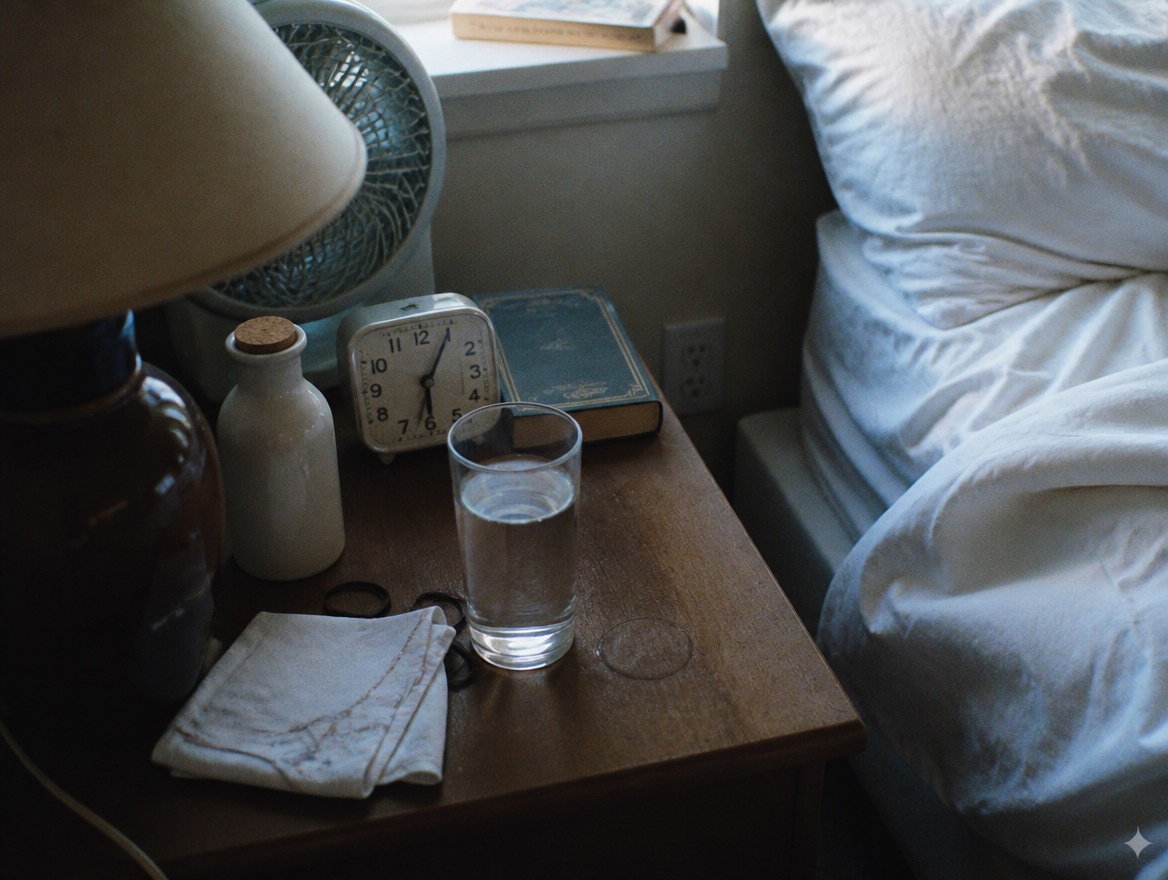
- Keep a glass of water on the bedside table for the actual middle-of-the-night sip after a flash. The point of that glass is small, deliberate replacement, not a full re-drink.
Caffeine and alcohol both worsen vasomotor symptoms for many women. Neither has to be eliminated, but tracking how each lands on a flash-heavy week is information worth having.
The bedside setup that helps
A few small changes around the bed reduce the cost of the bad nights, which is what most women actually want.
| Item | Why it helps |
|---|---|
| A glass of room-temperature water on the nightstand | A two-sip replacement after a flash is easier than getting up and easier than drinking nothing |
| A small carafe or insulated bottle | Reduces the trips to the kitchen; some women find the act of refilling the glass at 3 a.m. is itself disruptive |
| A folded cotton handkerchief or muslin cloth | Drying the face and neck without leaving the bed |
| A quiet bedside fan | Cools the skin faster after a flash; many women find this matters more than the air conditioning in the room |
| Cotton or linen bedding | Wicks better and dries faster than synthetics or heavy flannel |
| A second pillowcase within reach | Sometimes the easiest fix at 4 a.m. is changing the pillow rather than the body |
None of this is a treatment for hot flashes themselves. Treatment is a conversation with a clinician — options run from lifestyle through non-hormonal medications to menopause hormone therapy, depending on your history, symptoms, and preferences. The bedside setup is what keeps a flash from costing the rest of the night.
What’s worth flagging to a clinician
Night sweats that feel different from the hot-flash pattern — drenching the sheets, requiring a change of nightclothes, accompanied by weight loss, fevers, unusual fatigue, or new lumps — deserve attention beyond a hydration plan. So do hot flashes that are extreme enough to interfere with daytime function, sleep, mood, or relationships. The first appointment is often with whoever knows you best — primary care, gynaecology, or a menopause-trained clinician — and bringing two or three weeks of a simple log (frequency, severity, what helps) tends to make the visit useful.
The bottom line
The fluid loss from vasomotor symptoms is real but manageable. Two glasses of water across the morning, a salted breakfast, the drinking front-loaded into the day, a small bedside kit, and one clinician conversation if symptoms are heavy — that is the entire plan. It will not stop the flashes. It will keep them from running the next day, which is most of what midlife sleep actually needs.